


Acoustics
Topic
NRC (Noise Reduction Coefficient) is one of the most important metrics when specifying acoustic panels. Here's what it means and how to use it.




Acoustics
Author
FELTBAY
Author
date

Acoustics
Topic
NRC (Noise Reduction Coefficient) is one of the most important metrics when specifying acoustic panels. Here's what it means and how to use it.


If you've ever walked into a space that felt uncomfortably loud, echoey, or just hard to concentrate in, the problem was likely a low NRC rating on the surfaces around you.
NRC — or Noise Reduction Coefficient — is a standardised measure of how much sound a material absorbs. It's expressed as a number between 0 and 1, where 0 means the surface reflects all sound and 1 means it absorbs all sound. In practice, most acoustic panels fall somewhere between 0.45 and 0.95.
NRC values are determined through laboratory testing to standards such as ISO 354 and ASTM C423. Panels are tested at multiple frequencies and the results are averaged to give a single NRC figure. At FELTBAY, our 9mm, 12mm, and 24mm panels are independently tested to both ISO and ASTM standards, so architects and specifiers can trust the numbers.
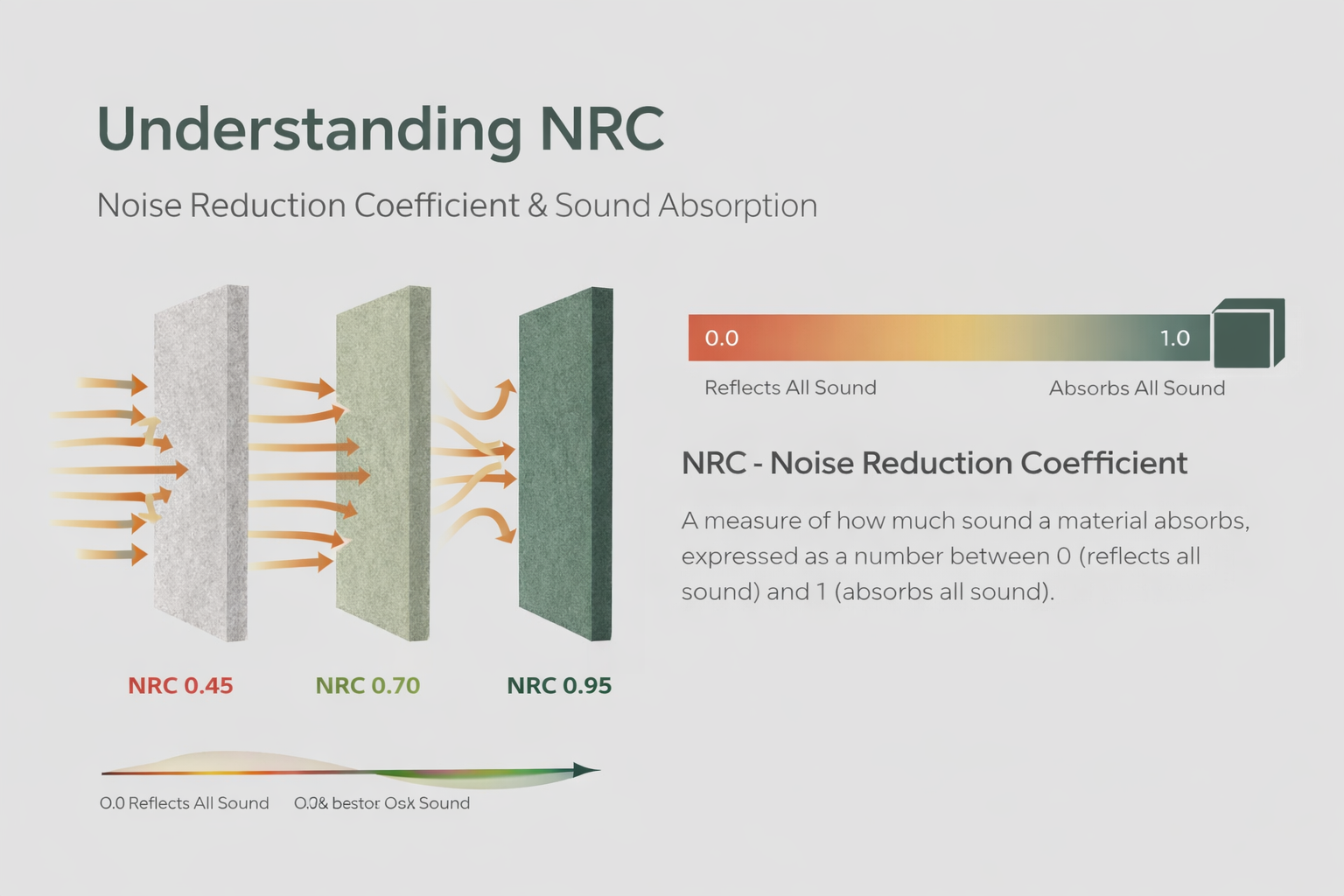
The right NRC depends on the application. Open-plan offices typically benefit from panels with an NRC of 0.70 or above. Classrooms and lecture theatres often require higher absorption, especially at mid-to-high frequencies where speech clarity is critical. Hospitality spaces like restaurants may prioritise a livelier acoustic environment and opt for lower-NRC panels used selectively.
Panel thickness directly impacts low-frequency absorption. Thinner panels (9mm) perform strongly at mid and high frequencies. Thicker panels (24mm) extend absorption into the lower frequency range, making them ideal for music rooms, conferencing spaces, and high-ceiling environments.
FELTBAY provides full acoustic test reports on request — including frequency-by-frequency data, not just a single NRC figure. This allows acoustic consultants and designers to model reverberation times accurately and make informed specification decisions.
Good acoustic design isn't about eliminating sound — it's about controlling it so that spaces feel comfortable, clear, and purposeful.
Contact the FELTBAY team to request technical datasheets and acoustic test certificates for all panel thicknesses and buildout configurations.
Latest